
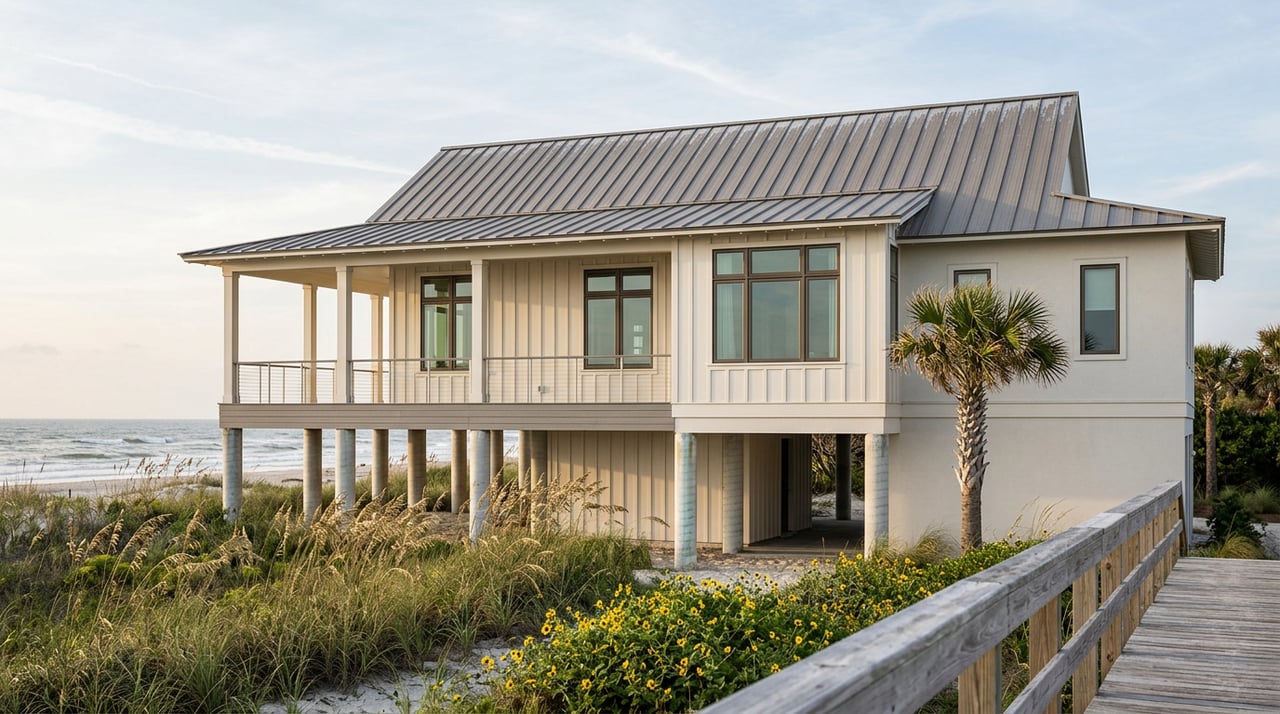
A buyer looking at a teardown lot in Indialantic's SOFA district pulls up the state's coastal mapping tool, sees the property sits landward of the red line, and assumes the hard part is over. It isn't. The Town of Indialantic runs its own coastal construction code, written in 1987, that sits on top of the state's rules and asks a different question entirely. Clearing the state's line tells you the Florida Department of Environmental Protection doesn't need to review your project. It tells you nothing about whether the town will issue the permit.
That distinction is the thing most people shopping oceanfront property here never get told, and it's the thing that actually decides whether a rebuild closes on schedule.
The map everyone checks, and the one they don't
The Coastal Construction Control Line, or CCCL, is the line most people have heard of if they've researched beachfront property anywhere in Florida. It's a jurisdictional boundary the state draws based on the expected reach of a 100-year storm, and it tells you whether the Florida Department of Environmental Protection has to sign off on construction or excavation seaward of it. It is not a setback. A structure can sit on the seaward side of the CCCL and still get built, but it needs a state permit to do it, and that permit comes with its own engineering standards for piling depth, elevation, and siting.
Buyers can check this themselves using the state's Map Direct tool, and Florida law requires sellers of affected land to disclose that a CCCL exists on the property before a purchase agreement is signed. That disclosure requirement, under Section 161.57 of the Florida Statutes, is well documented and gets covered in most CCCL explainers written for the coast.
What those explainers usually skip is the second layer.
Indialantic wrote its own rulebook in 1987
The Town of Indialantic has its own Coastal Construction Code, adopted in 1987 and still governing today, and it does not simply defer to the state's line. The town's code requires a variance from its Board of Adjustment before a permit can even be issued for a major structure built, in whole or in part, seaward of the coastal construction control line. It also defines its own local oceanfront setback, separate from the CCCL, written into the town's own zoning language. And for any application involving construction seaward of the line, the town requires certification from a licensed architect or professional engineer confirming the plans meet the coastal code's foundation and design standards, a requirement that goes beyond what a typical single-family building permit in Indialantic asks for.
In practice this means a property can be perfectly compliant with the state's CCCL rules and still need a variance hearing in front of the town before Indialantic will issue anything. That hearing has its own procedure, spelled out in the town's code of ordinances, and it is not something a buyer discovers by checking the state map alone.
Here's how the two layers actually compare:
| State CCCL (FDEP) | Town Coastal Code (Indialantic, 1987) | |
|---|---|---|
| Who administers it | Florida Department of Environmental Protection | Town of Indialantic Building Department and Board of Adjustment |
| What triggers review | Construction or excavation seaward of the state's mapped line | Any major structure seaward of the CCCL, or within the town's own defined oceanfront setback |
| What it requires | A CCCL permit or a no-jurisdiction letter from FDEP | A variance from the Board of Adjustment, plus architect or PE certification on the plans |
| Where you find it | FDEP's Map Direct GIS tool | Article II of the town's Code of Ordinances |
A buyer or listing agent who only checks the left column has checked half the rulebook.
The 30-year line that limits what you can rebuild
There's a third line worth knowing about, and it matters most to anyone buying an older oceanfront cottage with plans to expand it. The state's CCCL program also tracks a 30-year erosion projection line, and structures seaward of that line are generally not eligible for a new CCCL permit at all, with narrow exceptions for single-family homes meeting specific siting requirements. If an existing structure sits seaward of that 30-year line and gets destroyed by a storm, it can be rebuilt, but the rebuild cannot expand the capacity of the original structure. That's a meaningful constraint for anyone eyeing a small 1960s beach cottage with the idea of doubling its square footage on rebuild. The lot might allow it under the town's zoning. The 30-year erosion line might not.
The beach itself is under contract too
Part of why this matters right now is that the beach fronting Indialantic isn't static, and the county is actively managing it. Brevard County's South Reach shore protection project runs from Flug Avenue in Indialantic south to Spessard Holland Park, and renourishment work under that project was contracted for the 2025 to 2026 window. A wider, better maintained dune system changes the practical risk picture for insurers and for FDEP's own siting review, even though it doesn't change the legal lines themselves. Anyone weighing an offer on a beachfront lot right now is buying into a shoreline that's mid-project, not a fixed condition.
What the market numbers actually show, and what they hide
Indialantic is a small town, and that shows up in how much its headline numbers can swing. One tracking of closed sales over the three months ending July 2026 put the median sold price at $731,000, up 7.4 percent from the same period a year earlier, with a median of $342 per square foot and homes averaging 74 days on market, down from 94 days the year before. A separate snapshot taken in September 2026, covering a smaller pool of 23 closings, put the median closer to $560,000. Both can be accurate. In a town with only a few dozen closings in any given window, a handful of high-value oceanfront sales or a run of smaller inland cottages can move the median by six figures without the underlying market actually shifting.
That volatility is itself useful information. It means the median price you see quoted for Indialantic tells you less about any specific oceanfront parcel than the permitting history on that parcel does. A $2 million oceanfront lot and a $450,000 cottage three blocks inland both get folded into the same town-wide median, but only one of them has a variance hearing standing between contract and closing.
Before you write an offer on an oceanfront lot
A few things worth confirming before you're under contract, not after:
- Pull the CCCL location for the specific parcel using the state's Map Direct tool, and ask whether the property has an existing CCCL permit or a no-jurisdiction letter on file.
- Ask whether the property has ever gone through the town's variance process, and if so, request the file from the Board of Adjustment.
- If the existing structure sits seaward of the 30-year erosion projection line, confirm in writing whether a rebuild would be limited to the original footprint.
- Get a current survey that shows both the state's CCCL and the town's own oceanfront setback, since they aren't guaranteed to be the same line.
- Ask your insurance agent how the property's position relative to both lines affects premium and eligibility, before you're deep into due diligence.
A few straight answers
Does this apply to homes on the Indian River side of Indialantic, not the ocean side? No. The CCCL and the town's coastal code apply to sandy beach frontage on the Atlantic side. River and lagoon-facing property is governed by different setback and wetland rules.
Does a routine remodel trigger any of this? Generally, work that stays within an existing footprint and doesn't touch the foundation is treated differently than new construction or an addition that extends seaward. But any renovation classified as a substantial improvement can trigger a fuller compliance review, so it's worth confirming with the town's building department before assuming a remodel is exempt.
Who do I call first, the town or the state? Start with Indialantic's building department. They can tell you whether your specific parcel falls inside the town's variance requirement and point you toward what the state process will look like from there, rather than you working the two agencies separately.
If you're weighing an oceanfront purchase or getting ready to list a beachfront home in Indialantic, the permitting history matters as much as the price history. Island Pineapple Realty works this stretch of the barrier island regularly and can walk you through what a specific parcel's CCCL and town-code status actually means before you're under contract. Request a free home valuation and we'll start with the lines that actually govern your lot, not just the ones on the state's map.