
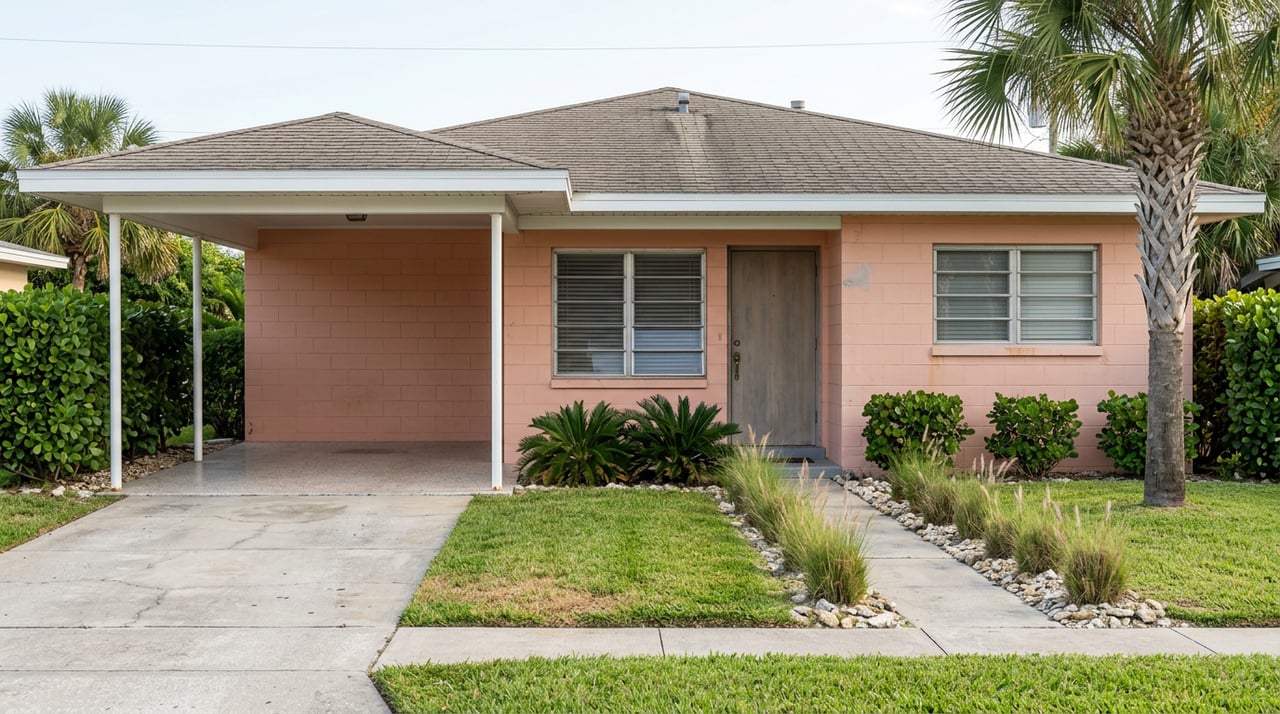
Picture this. You accept a strong offer on your Indian Harbour Beach home. The buyer loves the layout, the price works for both sides, and everyone signs. Three weeks later, your agent calls with the kind of news nobody wants two weeks before closing. The buyer's insurance underwriter came back with a problem on the 4-point inspection, the lender won't fund without a policy in place, and now you're renegotiating a deal you thought was done, or watching it collapse entirely.
This is not a rare edge case on the barrier island. It is close to the default scenario, and the reason has nothing to do with how well you staged the living room.
The house isn't the problem. The paperwork is.
Every Florida home over a certain age has to clear an insurance checkpoint before a lender will fund a mortgage, and that checkpoint has almost nothing to do with buyer sentiment. It's called a 4-point inspection, a narrow review of four systems: roof, electrical, plumbing, and HVAC. Citizens Property Insurance Corporation, the carrier of last resort for a large share of Florida homeowners, requires a passing 4-point for any home 20 years or older before it will write a policy, and most private carriers apply a similar 20 to 30 year threshold of their own.
Run the math on Indian Harbour Beach and the exposure becomes obvious. The median home here was built in 1979, which puts half the city's housing stock past that 20-year line by nearly three decades. Roughly 30 percent of the housing was built between 1940 and 1969, and in Golden Beach Estates, one of the barrier island's named subdivisions between the Indian River and the Atlantic, original construction peaked in 1966. A five bedroom home in that neighborhood at 929 Bluewater Drive still carries a 1965 build year on record. These are not outlier properties waiting to be flagged. They are close to the median.
The roof carries most of the weight in that inspection, and the rules by material are specific enough to change how you should think about your own listing timeline.
| Roof material | Typical insurable window | What happens after that |
|---|---|---|
| Asphalt shingle | 15 to 20 years | Carrier requires inspection proving 5 years of remaining life; many decline past 15 to 20 |
| Metal | 30 to 40+ years | Longest runway, generally the easiest to insure |
| Clay or concrete tile | 25 to 40 years | Underlying materials can degrade before the covering does |
| Flat roof | 10 to 15 years | Hardest to insure, many carriers cap coverage well below that |
Florida law since 2022 prohibits an insurer from refusing to issue or renew a policy solely because a roof is under 15 years old and passes inspection. That protection stops mattering the moment your roof crosses that line, which on a house built in the 1960s or 1970s, it almost certainly has unless someone already replaced it.
A form most sellers have never heard of just changed
On top of the age threshold, Florida rolled out a significant revision to the official wind mitigation form, OIR-B1-1802, effective April 1, 2026. It is the first major update to that form in over a decade. The new version demands more specific documentation for every feature it evaluates, roof covering, roof deck attachment, roof-to-wall connections, roof geometry, opening protection, and secondary water resistance, and it requires permit numbers and application dates that the old form never asked for.
Insurance companies started applying credits based on the new form in July, which means the transition is already live for anyone listing an older Indian Harbour Beach home right now. An inspection completed on the old form before April 1 may still be accepted by some carriers, but a fresh inspection under the new form could produce a different result, better in some cases, stricter in others, depending on what your home actually has documented.
None of this is optional paperwork a buyer can skip. It is the difference between a lender funding a loan on schedule and a deal stalling while everyone scrambles for a workaround.
Why the days-on-market numbers don't agree with each other
Two live data sources on Indian Harbour Beach right now tell almost contradictory stories, and the gap is worth sitting with. Redfin's February 2026 read put the median sale price at $483,000, down 1.3 percent year over year, with homes taking an average of 91 days to sell, up sharply from 63 days the year before. Homes.com's August 2026 snapshot shows a median list price of $499,900 with homes moving in an average of just 56 days, and listings spanning from $189,000 up to $7,000,000.
Those numbers aren't measuring different markets. They're likely measuring different segments of the same one. A slower overall average pulled up by homes that sit for months waiting for a buyer whose financing survives the insurance gauntlet, sitting alongside a faster-moving tier of updated, easily insurable properties that go under contract quickly because nothing in the 4-point or wind mitigation report slows the loan down. If your roof, panel, and plumbing are recent, you're likely competing in the 56-day pool. If they aren't, you may be looking at something closer to the 91-day pool, regardless of how well your home shows.
The buyer isn't just evaluating your house. Their lender is evaluating whether an insurance company will accept it, and that verdict now arrives on a freshly rewritten form.
What actually trips the wire
A handful of specific findings show up again and again as the reason a 4-point comes back with a problem, and none of them are cosmetic:
- Federal Pacific, Zinsco, or Challenger electrical panels. These older panel brands are common decline triggers, independent of how the rest of the electrical system looks.
- Polybutylene plumbing. Gray plastic supply pipes from this era are treated as a red flag by most carriers.
- Roofs past their material's insurable window. A 17-year-old shingle roof might still pass a five-year remaining-life test, but expect a shift from replacement cost coverage to actual cash value, which changes what a claim actually pays out.
- Missing permit documentation for prior roof work. Under the new OIR-B1-1802 form, permit numbers and application dates carry real weight in how much credit a home receives.
Getting ahead of it before you list
Sellers of pre-1980 barrier island homes have a genuine advantage available to them that most never use: ordering the 4-point and wind mitigation inspections before a buyer's lender forces the issue. Several Brevard County firms handle both routinely, including True Home Inspections, Cypress Inspections, SureHome of Brevard, Fox Inspections, and Honor Services, and Brevard Home Inspections and Engineering specifically serves properties near Gleason Park in Indian Harbour Beach. A standalone 4-point typically runs in the neighborhood of $75 to $200, and a wind mitigation inspection costs about the same, often less when bundled together.
If the reports surface a real weakness, roof-to-wall connections that need reinforcement, or windows that don't meet current opening protection standards, the state's My Safe Florida Home grant program, reopened since August 2025, offers a 2-to-1 match up to $10,000 for eligible upgrades. The catch is that you need a wind mitigation inspection first to document the weakness before you can apply, which is one more reason to order it early rather than after an offer is already on the table.
Getting these reports in hand before you list does two things at once. It tells you exactly which repairs would move your home into the faster-selling tier, and it gives your buyer's lender clean paperwork from day one instead of a surprise three weeks before closing.
A few questions worth settling before you sign
Does a newer roof mean my house will automatically pass? No. The 4-point inspection looks at all four systems together. A brand new roof sitting above a Federal Pacific panel or polybutylene plumbing can still fail the review.
If I already have a wind mitigation report from last year, do I need a new one? Reports are generally valid for up to five years unless a carrier requires otherwise, but the new OIR-B1-1802 form took effect April 1, 2026, and a fresh inspection under it could change your credit, for better or worse, depending on what's documented. Ask your insurance agent directly before assuming an older report still applies.
Is the 4-point the same thing as the home inspection a buyer already orders? No. A full home inspection covers far more ground and takes two to three hours. The 4-point is narrower, focused only on the roof, electrical, plumbing, and HVAC, and exists purely to satisfy the insurance carrier's underwriting question.
Selling a home built decades before these rules existed doesn't have to mean losing weeks to a surprise at the underwriting stage. It means finding out what your house actually has on record before a buyer's lender does. If you're weighing whether to list a barrier island home in Indian Harbour Beach this year, Island Pineapple Realty can walk through what a current inspection would likely show and what it's worth ahead of a listing. Request a Free Home Valuation and let's look at the numbers together.